Aug 28, 2026Activewear Manufacturing Insights
How Long Does UPF Protection Last in Activewear? What Brands Should Know
How long does UPF protection last in activewear? There is no universal wash-count answer. Learn how fabric construction, UV finishes, testing, and washing affect UPF performance.
How Long Does UPF Protection Last in Activewear? What Brands Should Know
A client recently asked me:
“Do you know approximately how many washes this UPF treatment lasts?”
It sounds like a simple question.
But honestly, it is a very good question.
When developing activewear with UPF protection, I don't think it is responsible to simply give a number such as “30 washes” or “50 washes” without knowing more about the fabric, the treatment and the testing conditions.
There is no universal wash-count answer for how long UPF protection will last.
The actual performance can depend on the fabric construction, the type of UV protection, the finishing process, and how the garment is washed and used.
That is why, for one of our current compression-fabric projects, we are taking a more careful approach.
First, test the fabric itself
Before adding a UV finish, we want to understand how much UV protection the fabric already provides.
A tightly constructed, dense fabric may already provide a certain level of UV protection because of its structure.
For compression activewear, this is particularly important.
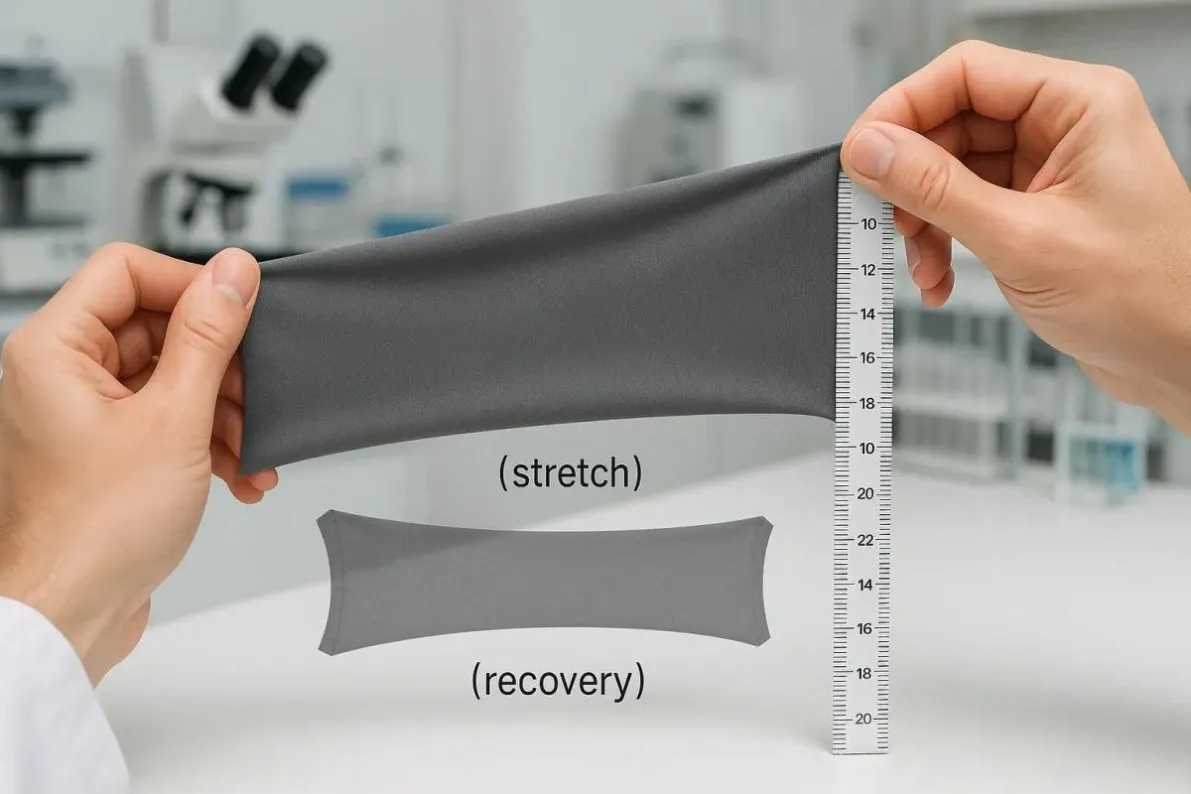
The fabric needs to stretch while maintaining good coverage and recovery. When the fabric is stretched, its construction and coverage can change, which can also affect how much UV radiation passes through it.
So the first question should not always be:
“Which UV finish should we use?”
Sometimes the better question is:
“How much UV protection does the fabric already provide?”
Testing helps us answer that question instead of making assumptions.
Second, use a UV finish only when it is needed
If the fabric already performs close to the target UPF level but does not quite reach it, a UV finish may be one possible solution.
But I would rather use the minimum finishing solution necessary than automatically add a treatment.
Why?
Because activewear is not just about one specification.
The same fabric also needs to maintain:
- Stretch and recovery
- Breathability
- Hand feel
- Fabric weight
- Comfort during movement
- Durability after washing
You don't want to solve a UPF requirement by creating another problem somewhere else.
For example, a finish that changes the hand feel or affects the fabric's performance may not be the right choice for a high-stretch compression garment.
Third, check whether UV protection is already built into the fabric
We are also checking with the fabric supplier to see whether a suitable compression fabric with built-in UV protection is available.
This can sometimes be a better development route than adding a separate finishing process.
The important point is to compare the actual fabric options rather than assuming that one solution is always better.
For a brand developing a new activewear collection, the right question is not simply:
“Can you add UPF?”
It is:
“Which solution can achieve the required UPF performance while maintaining the other properties of the garment?”
So, how many washes does UPF protection last?
This is where I would be careful with a simple answer.
It depends.
A UPF claim should be supported by appropriate testing rather than a manufacturer's guess about how many times a garment can be washed.
UV protection can come from the fabric's construction, from fibers or materials used in the fabric, from a finishing treatment, or from a combination of these factors.
And these different approaches can behave differently during repeated washing and real-world use.
For UV-protective textiles, standardized testing methods exist to measure UV transmission/blocking and to evaluate textile performance after simulated conditions such as laundering and other exposures. AATCC TM183 is used to measure UV radiation transmission or blocking through fabrics, while ASTM D6544 describes preparation involving laundering, simulated sunlight and chlorinated pool water for UV-protective textiles.
That is why I prefer to test first and make the performance claim based on the actual result.
What does this mean for an activewear brand?
If you are developing UPF activewear, I would recommend looking at the development process as a whole:
Fabric → Construction → UV performance → Finishing → Washing → Final testing
Rather than:
UPF requirement → Add a finish → Done
The first approach gives us more information before making a production decision.
And it also reduces the risk of solving one product requirement while unintentionally affecting another.
For compression activewear especially, the balance between UV protection, stretch, recovery, breathability and comfort matters.
A technically impressive fabric on paper is not necessarily the best fabric for the finished garment.
One thing I always remind myself during product development
Don't promise a specification before you verify it.
This is particularly important when a product is expected to perform after repeated washing and real use.
As a manufacturer, it is sometimes tempting to give a quick answer because the customer simply wants a number.
But a better answer is sometimes:
“Let us test it first.”
That may take a little longer during development, but it gives the brand something much more valuable than a quick promise:
confidence in the final product.
Final thought
When developing UPF activewear, would you prefer:
Built-in UV protection in the fabric, or a UV finishing treatment?
There isn't necessarily one answer for every product.
The right solution depends on the fabric, the target performance, the garment construction and the intended use.
And that is exactly why we prefer to evaluate the fabric first before deciding how to achieve the final specification.
If you're developing compression wear, sportswear or other activewear with specific fabric-performance requirements, feel free to share the target specification with us. We can look at the fabric and development route together.
Quick Answers About UPF Activewear
How long does UPF protection last after washing?
There is no universal number of washes that applies to all UPF activewear. Durability depends on the fabric construction, type of UV protection, finishing method, washing conditions and testing requirements. The actual fabric or garment should be tested rather than relying on a general wash-count claim.
Is built-in UV protection better than a UV finish?
Not necessarily. Built-in UV protection and UV finishing can both be suitable depending on the fabric and product requirements. The best solution should maintain the required UPF performance while also preserving stretch, recovery, breathability, hand feel and comfort.
Should UPF fabric be tested after washing?
If the product is expected to maintain a UV-protection claim after repeated use and washing, testing under appropriate conditions is important. AATCC TM183 provides a method for measuring UV transmission or blocking through fabrics, while ASTM D6544 covers preparation of UV-protective textiles using simulated laundering and other exposure conditions.
What should brands consider when developing UPF compression activewear?
Brands should consider more than the UPF value itself. Fabric stretch and recovery, density, breathability, hand feel, weight, comfort, washing durability and the final garment construction should all be considered during development.